



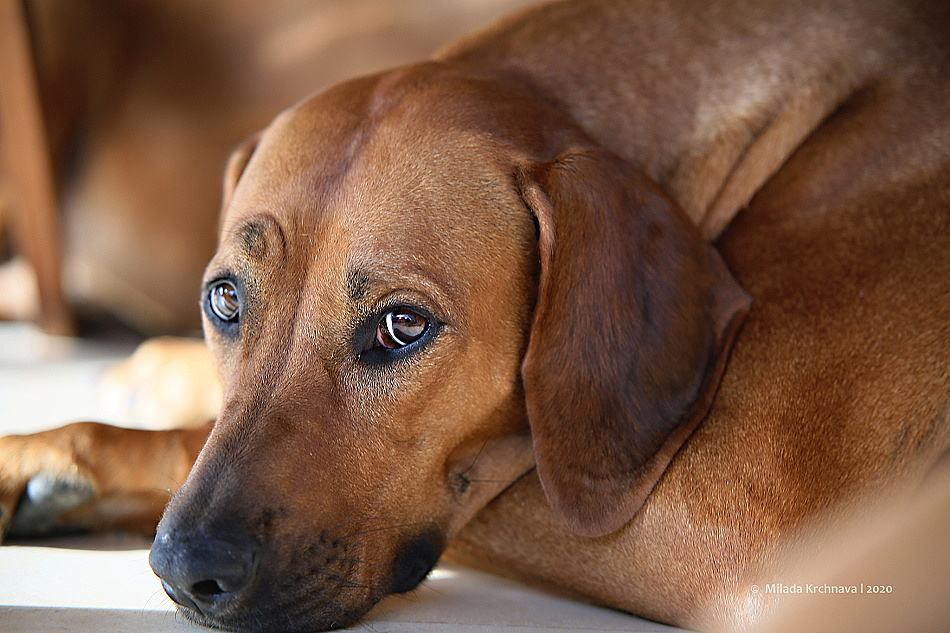


The price of a puppy is one of the questions almost every breeder is asked. At first glance, the price may seem high, because many people only see the last few weeks of the puppy’s life with its mother. They see a small puppy, a bowl, a blanket, the first vaccination, and the moment it leaves for its new home.
However, the true value of a responsibly bred puppy is created long before it is born. Behind every litter are years of work, planning, experience, investment, and responsibility. The price of a puppy is therefore not simply the cost of eight weeks of raising it. It is the result of everything the breeder had to do long before the first puppy was ever born.
With the Rhodesian Ridgeback breed, it is also important to distinguish between a puppy that does not meet the breed standard and is intended exclusively as a family companion, a puppy that meets the standard and is suitable as a high-quality family dog, and a puppy that is standard, may come from an exceptionally high-quality combination, and may have greater breeding and show value. This distinction says nothing about how much joy, love, and loyalty the dog will bring to its family. It primarily refers to the dog’s potential in terms of showing, breeding, and its future contribution to the breed.
1. The Quality of the Parents and the Value of the Bloodline
The foundation of a puppy’s price begins with the quality of its parents. A responsible breeder does not plan a litter randomly. They study pedigrees, the strengths and weaknesses of individual lines, health, structure, temperament, and the overall benefit that the planned mating may bring to future offspring.
When evaluating the breeding value of an individual dog, it is not only about how the dog or bitch looks at first glance. What also matters is the dog’s own value, results, health status, the quality of its ancestors, siblings, and later even the quality of its offspring. In other words, ethical breeding does not assess only what is visible on the outside, but also what the dog may pass on to the next generation.
A dog’s own utility and breeding value are reflected in its results at dog shows, breed surveys, possibly working trials, health examinations, and other evaluations. If the dog and bitch meet the conditions for inclusion in breeding, have completed the required shows or breed survey, and at the same time meet health criteria, they are considered individuals of high breeding value.
It is only logical that a responsible breeder should never mate their bitch to a dog they know does not produce quality offspring, or whose combination would bring no positive progress to the breeding program. Unfortunately, such cases do happen when some breeders do not devote enough time to education and gathering information. That is precisely why puppies from high-quality, carefully planned combinations are more expensive than puppies from average pairings.
2. Dog Shows, Titles, and Breeding Qualification
Many people do not realize how much effort, time, and money it takes before a quality dog or bitch becomes a breeding animal with proven results.
Dog shows are not just pretty photos or videos from the ring. At a show, an FCI judge evaluates body structure, overall balance, movement, expression, topline and underline, movement mechanics, pigmentation, dentition, ridge, and the dog’s overall conformity to the breed standard. A show is also a way for an independent judge to confirm whether the individual is truly of quality in terms of exterior and whether it is suitable for further breeding use.
Entering a dog or bitch in an international dog show is only the beginning. The entry fee is usually around €50–60 per dog. To the cost of the show itself must then be added travel expenses, fuel, motorway tolls, food, suitable clothing for the ring, preparation of the dog, conditioning, training lessons, grooming, and possibly a professional handler.
And most importantly, a championship title is not earned automatically simply by entering several shows. The dog or bitch must repeatedly succeed in competition. That means more shows, more travel, more time, and more expense.
If a dog or bitch has multiple titles, multiple championships, or titles from several countries, this means further travel, hotels, fees, and repeated investments. All of this also becomes part of the price of future puppies, because the show career and breeding qualification of the parents are one of the proofs of their quality. Quality individuals often have many show successes, high ratings at breed club shows, and completed championships from several countries.
For example, in Slovakia, for a Slovak owner to obtain the title of Slovak Champion, the dog must win first place with the CAC award four times under different judges. In practice, this means that for one show weekend, the owner usually enters the dog for all three days. The entry fees alone can amount to approximately €180. On top of that there is parking, fuel, clothing, handling lessons, or, if the owner does not show the dog personally, a handler who provides this service for a fee, as well as food, dog treats, and grooming. This means around €250–500 in additional costs for just one weekend, during which the dog still may not place first all three times.
If the show takes place abroad, fuel, motorway tolls, and accommodation must be added, which means another approximately €500 if the show is in the Czech Republic, Hungary, Austria, or Poland. If the destination is farther away, the total cost is naturally much higher. In Slovakia, as well as in other countries, once the requirements for the Champion title are met, the dog may, under clearly defined conditions, go on to earn additional titles such as Grand Champion SK, Super Grand Champion, Champion SKJ, and others.
Estimated cost:
in Slovakia, approximately €400–600 for one show weekend / 3 show days
abroad, approximately €500–1,000+ for one show weekend / 3 show days
3. Health and Genetic Testing of the Parents
Responsible breeding does not begin with the litter, but with the health of the parents.
Before a dog or bitch is included in a breeding program, they must undergo the required health examinations. Depending on the breed and the breeder’s level of responsibility, these most often include orthopedic screening, genetic testing, DNA profiling, or other specialized examinations. These tests are not cheap, and they are done with no guarantee that the results will be ideal. If the results are not satisfactory, the dog may not be included in breeding at all, and all of the money invested is simply lost.
This is where one of the biggest differences lies between an ethical breeder and someone who simply produces puppies. A responsible breeder does not want to produce puppies “just to see what happens”; they want to know the health status of the parents before planning a litter.
Estimated cost: approximately €450–900 or more, depending on the extent of the examinations and the number of tests.
4. Preparing the Female Before Mating
Before a bitch is ever bred, she must be in excellent condition. It is not enough for her to simply appear healthy. She must be fed correctly, given quality supplements, have good immune support, and be prepared physically as well as reproductively.
Before mating, various examinations are often performed to help determine the correct timing and to verify the bitch’s reproductive health. These may include mycoplasma testing, cytology, progesterone testing, and other checks. This stage is extremely important, because poor timing may result in an unsuccessful mating.
Progesterone testing is usually not done just once. It is often repeated several times until the ideal moment is established. To this must be added sample collection, veterinary visits, and other expenses before the bitch even travels to the stud dog.
Estimated cost: approximately €250–350, depending on the number of examinations and controls.
5. The Mating, Travel to the Stud Dog, and the Stud Fee
The mating itself is another significant financial item.
The owner of the bitch must pay a stud fee for the dog. Of course, much depends on whether the breeder chooses a quality stud dog with an excellent pedigree and the potential to bring positive traits to the litter, or whether they simply go to the nearest available dog without deeper consideration of the value of the combination. A responsible breeder chooses the mating based on quality, not proximity.
If the breeder wants to bring new blood, an interesting line, or new qualities into the breeding program, they often travel abroad to a quality stud dog. This means additional expenses for travel, fuel, motorway tolls, accommodation, food, and often more than one trip. In some cases, insemination is also necessary.
Estimated cost without the stud fee: approximately €150–350
With the stud fee, travel, hotel, and other expenses: approximately €2,500–3,500 or more
If the trip to the stud dog is to a country more than 1,000 km away, the total cost is naturally much higher.
There are also cases where breeders import frozen or chilled semen from an interesting stud dog. In such cases, the costs include collection, storage, transport, veterinary procedures, and the special container used for shipping the semen dose. The total can easily rise above €3,000.
There are also exceptional cases in which, after establishing contact and reaching an agreement with the stud dog’s owner, the owner lends their stud dog to us in Slovakia. We have had two such dogs with us. In 2010, we brought a dog from Canada with unrelated bloodlines in Europe and excellent breed type, Thornberry Akala, Champion of Canada and the USA, who lived with us and our RR girls for two months. Then in 2024, we had a dog from Brazil, BISS, Multi Grand Ch., Multi Ch. Robert Redford II of Malabo APD, who lived with us for six months. These exceptional cases clearly show how much effort and expense may be involved in bringing new, high-quality, and interesting bloodlines into a breeding program.
6. Pregnancy and Preparation for Whelping
When the mating is successful and the bitch becomes pregnant, the costs do not end. On the contrary, they continue.
A pregnant bitch needs high-quality food, appropriate supplements, immune support, peace, and careful monitoring of her health. In addition, everything must be prepared for whelping — a whelping box or pen, dry beds, blankets, pads, disinfectants, paper towels, a heating pad, towels, scissors, a suction device, and a whole range of other supplies.
Later, it is also necessary to prepare the garden and the environment so that the puppies have safe access outdoors and can be properly socialized in an outside environment. This often means additional pens or fencing, a safe resting place for the puppies, and a room with either air conditioning or heating.
A conscientious breeder must think ahead and have everything ready before the litter is born. This is another part that an average puppy buyer does not see, but in practice it is a very important and financially significant item.
Estimated cost: approximately €700–900 or more, depending on what the breeder already has and what must be purchased new.
7. Whelping and Possible Complications
Whelping may be natural and uncomplicated, but it can also become difficult very quickly. This is where it becomes obvious that breeding carries not only financial risk, but also significant emotional and psychological strain.
Sometimes longer monitoring, veterinary assistance, or emergency intervention is needed. In some cases, a C-section is unavoidable. The breeder must be prepared to act immediately, regardless of the time of day, fatigue, or any other circumstances. This is not only about money, but about the health and lives of both the bitch and the puppies.
In the case of an uncomplicated whelping: approximately €100
In the case of complications or a C-section: approximately €450–1,500 or more
8. Raising the Litter from Birth Until They Leave
The least visible, but often most demanding, stage begins after the puppies are born.
Many people think puppies simply lie next to their mother and grow. The reality is completely different. The breeder must monitor whether all puppies are nursing, whether they are gaining weight evenly, whether the mother may accidentally lie on them, whether they are thriving, weigh them daily, change pads, wash bedding, disinfect, clean, and later feed them several times a day. If the litter is larger, or if some puppies need supplemental feeding, this becomes round-the-clock care, day and night.
By eight weeks of age, puppies consume an enormous amount of food. If a litter goes through, for example, eight 20 kg bags of kibble at €90 each, that is €720 for food alone. On top of that come milk replacer, supplements, disinfectants, paper towels, pads, dry beds, water, laundry, and the overall cost of running the litter.
Raising a litter is also not only about feeding and cleaning. It is about socialization, contact with people, household sounds, movement, early experiences, and the foundations that the puppy carries with it for the rest of its life.
Estimated cost: approximately €1,000 and up, and significantly more for large litters.
9. Veterinary and Administrative Costs for Each Puppy
At the end of the raising period come the costs that most people notice first — vaccinations, microchipping, passport, veterinary checks, registration, and pedigree papers. But this is only the final stage of the entire process.
Each puppy must be regularly dewormed, veterinary checked, vaccinated, microchipped, and properly documented. These costs are multiplied by the number of puppies in the litter. With a larger litter, this becomes another substantial amount that the breeder must cover before the puppies leave for their new homes.
Estimated cost per puppy: approximately €100–130 or more
For a litter of six to eight puppies, this may amount to approximately €500–1,500 or more
10. The Breeder’s Time, Experience, and Responsibility
There is still one more factor that is the hardest to calculate, yet enormous — the breeder’s time and responsibility.
A breeder does not invest only money. They invest hundreds of hours of their time. They monitor their bitch, plan the mating, organize examinations, travel, prepare for whelping, often lose sleep, supervise the litter, feed, clean, socialize, communicate with potential owners, select suitable families, prepare contracts, and remain available to the new owners even after the puppy has left.
This is work that most people do not fully realize. And yet, this is precisely where the difference lies between a responsible breeder and someone who simply sells puppies.
If this work were calculated at its real value in terms of time, it would amount to hundreds or even thousands of euros more. Most ethical breeders, however, never fully include this in the puppy’s price.
The Difference Between a Non-Standard, Standard, and Highly Promising Standard RR
With Rhodesian Ridgebacks, it is always important to keep in mind that not all puppies have the same value in terms of future use.
A non-standard RR is a dog or bitch with a pedigree that does not meet one of the breed standard requirements for further showing or breeding. This may include, for example, a non-standard ridge, extra crowns, a single crown in the ridge, no ridge, excessive white markings, a kinked tail, or another deviation from the standard. In most cases, however, these faults do not reduce the dog’s value as a family companion. A non-standard RR can still be just as healthy, beautiful, loving, and loyal — it is simply not intended for further breeding or a show career.
A standard RR is a dog or bitch with a pedigree that conforms to the breed standard in terms of exterior. Such a dog may be an excellent representative of the breed, a beautiful and high-quality family dog, and, if additional conditions are met, also an individual suitable for showing and breeding.
However, it is important to understand that not all standard puppies are equal in terms of future breeding value. Some standard puppies are primarily intended to become high-quality family companions. Others come from exceptionally well-planned combinations, from highly valuable parents with interesting pedigrees, excellent genotype and phenotype, and may represent a genuine contribution to the future of the breed.
This is where another price difference arises. A standard puppy from a good but more ordinary quality combination and a standard puppy from exceptionally high-quality parents with an interesting pedigree are not the same from a breeding perspective. In the latter case, the puppy does not simply meet the standard — it also carries genetic potential that may be interesting and valuable to other breeders and to the future of the breed.
Such puppies are often the result of long-term planning, frequently involving international matings, careful bloodline selection, and combinations designed not only to produce beautiful puppies, but also to make a meaningful contribution to Rhodesian Ridgeback breeding. For this reason, it is natural that their price is higher than that of a standard puppy that is high quality but intended primarily as a family dog rather than as a promising future breeding individual.
The difference in price therefore does not depend only on whether the puppy is standard or non-standard. A very important distinction also exists between a standard puppy intended mainly as a family dog and a standard puppy with high breeding value, from exceptionally high-quality parents and an interesting pedigree, that may be an asset for future breeding.
Approximate Price Differences Between the Different Types of Puppies
Generally speaking:
- a non-standard RR is intended primarily as a family dog, and its price is usually lower: €1,200–1,800
- a standard RR suitable mainly as a high-quality family dog is usually in the mid price range: €1,800–2,000
- a standard RR from highly valuable parents, with an interesting pedigree and higher breeding or show value is usually priced higher, because it carries greater potential for future breeding and is often the result of an exceptionally well-planned combination: €2,000–3,500
The price is therefore determined not only by whether the puppy is standard or non-standard, but also by the quality of the combination, pedigree, health results of the parents, breeding potential, and the overall value that the particular combination brings to the breed.
Conclusion
The price of a Rhodesian Ridgeback puppy is not the price of eight weeks of life. It is the price of years of work, the quality of the parents, health and genetic testing, shows, titles and breeding qualification, carefully selected mating, preparation of the bitch before mating, pregnancy, whelping, the risk of complications, the demanding raising of the litter, veterinary and administrative procedures, and finally the breeder’s time, experience, and responsibility.
A responsibly bred puppy is not expensive because the breeder is “asking too much.” It is expensive because responsible breeding requires a great deal of time, a great deal of money, and an even greater amount of responsibility.
And that is precisely the difference between price and value


